
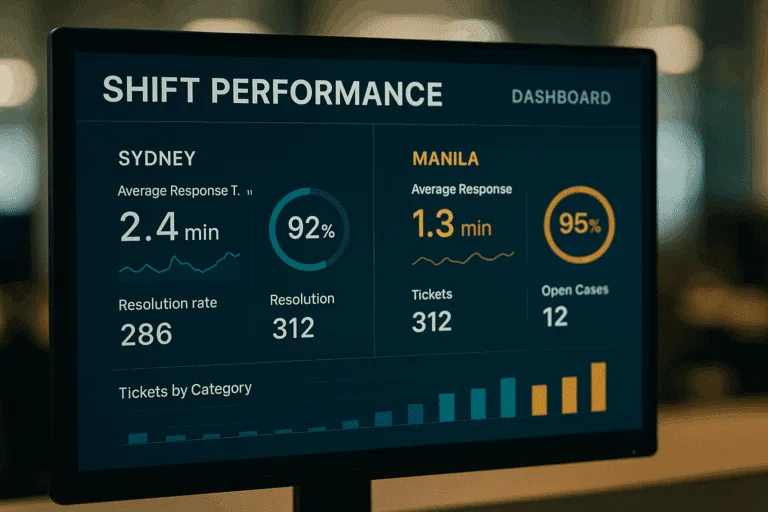
Split-Shift Teams give Australian companies a practical way to deliver round-the-clock service without exhausting local staff or blowing out payroll. By pairing shorter roster blocks across Sydney and Manila, you keep queues moving, maintain quality at odd hours and free your home team to focus on complex, high-value cases when they are freshest and most supported.
Picture one customer queue, one help desk and two coordinated sites. Local agents handle VIP accounts and tricky troubleshooting in core business hours. Their counterparts offshore cover evening and early morning peaks, resolving common issues and prepping cases that need senior attention at sunrise. With clear ownership, templated notes and time-boxed work blocks, Split-Shift Teams feel seamless to customers who simply experience fast, consistent answers.
Customer expectations have shifted to instant replies on chat, email and phone. Budgets have not. Instead of paying local night penalties or asking a few people to stretch beyond healthy limits, Split-Shift Teams align energy with demand. Shorter stints sustain focus, time zone pairing removes dead hours, and documented handovers prevent the dreaded repeat story. The result is happier customers, steadier staff and a cleaner cost curve.
Start with evidence, not guesswork. Export three months of interactions, then chart volume by the hour for each channel. Mark windows with high drop-off, refunds or churn. Those are your priority blocks. Assign local experts to the hours with complex diagnostic work and relationship-heavy tasks. Allocate offshore specialists to complementary windows where speed and accuracy matter most. With disciplined handovers, Split-Shift Teams shrink first response times and lift first-contact resolution.
Build a weekly grid in 30-minute blocks so gaps are obvious. Pair people, not just regions, and schedule a daily overlap for live handovers. Protect safe rest periods, limit late finishes in a row and guarantee at least one consecutive day off. Publish the grid where everyone can see it, and review it weekly so the plan follows demand rather than habit. When you treat the roster as a living design, Split-Shift Teams stay efficient and humane.
Use one source of truth for tickets, connected to chat and phone so nothing hides in private inboxes. Create saved replies for common questions, short screen recordings for fiddly fixes and tags that label topics, warranties and billing. Dashboards should show first response time, open by priority, aged tickets and escalations. With the right foundation, Split-Shift Teams avoid double handling and customers avoid repeating themselves.
Teach the work the way the work is done: short, visual and searchable. Each SOP should explain why the task matters, when to use it, step-by-step actions, screenshots and exception rules. Convert SOPs into 10-minute microlearning modules with quick quizzes, then schedule side-by-side practice in both directions so tone and methods align. When training is layered and continuous, Split-Shift Teams keep a single brand voice across every channel.
Adopt a light scorecard that rates three things: accuracy, empathy and follow-through. Sample a handful of interactions per person each week, then discuss trends in a short huddle. Calibrate often so scores mean the same thing across sites. Feed findings into coaching plans, and celebrate wins publicly so the right behaviours spread. With thoughtful QA, Split-Shift Teams improve steadily without adding bureaucracy.
Respect Australian awards and penalties, Philippine labour rules and public holidays in both countries. Standardise security with role-based access, password managers and clean-desk habits. Provide ergonomic guidance for home offices and make mental health resources easy to access. Publish workloads and queue health so leaders can redistribute before pressure spikes. When compliance and care are baked in, Split-Shift Teams protect people as well as customers.
A national coaching business sees surges when parents confirm venues, adjust timetables and ask billing questions after dinner. Offshore agents can clear routine changes and update schedules overnight, while local staff resolve safeguarding and complex refund cases in the morning. Coaches start their day calm, parents get quick answers and weekend fixtures stop wobbling. With the same queue and shared playbooks, Split-Shift Teams keep season momentum even during weather-driven chaos.
An engineering firm can route CAD ticket triage and standard QA checks to the offshore site late in the day. By morning, Australian engineers receive cleanly documented issues and prepped files, ready for deep work instead of inbox firefighting. Project managers see predictable progress and fewer surprises because ownership, timestamps and next actions are always visible. This is how Split-Shift Teams turn overnight hours into forward motion on every job.
Week one: baseline volumes, define response and resolution targets, and draft the coverage grid. Week two: pair people across sites, set two live handover windows and write the first ten SOPs. Week three: switch on dashboards, run microlearning modules and start shadowing both ways. Week four: go live in limited hours, complete one quality pass and publish results to the team. Iteration is the secret: small weekly tweaks keep Split-Shift Teams aligned with real demand.
Track first response time, first-contact resolution, customer satisfaction, reopened rate and escalations. Layer in occupancy and schedule adherence to balance workloads. Compare results by time block rather than by geography to keep analysis fair. Once a month, follow two customer journeys end to end to test how the system felt in the real world. If numbers look promising, extend the roster blocks and let Split-Shift Teams cover more of the day.
Fuzzy ownership slows everything. Name an owner and a due time on every ticket. Bloated notes waste handover minutes. Use a three-line template: last action, next action, blocker. Tool sprawl creates blind spots. Consolidate platforms and remove duplicate apps. Cultural drift erodes tone. Hold joint standups and rotate facilitators so both sites contribute. Overloaded onboarding overwhelms new hires. Stage skills in layers and certify before adding complexity. With these small disciplines, Split-Shift Teams stay crisp and predictable.
Customers want help now, not tomorrow morning, and they judge your brand by how quickly you respond and how clearly you follow through. With a single source of truth, clean SOPs and a people-first roster, Split-Shift Teams deliver that speed every day. Start small, measure openly and improve weekly. Your customers will notice the faster replies, your staff will feel the rhythm and your budgets will thank you for the stability.
If you want to see how this could work in your queue, book a free discovery call and we will map coverage blocks, estimate costs and outline handovers tailored to your use case: https://www.workmatepro.com/free-strategy-call/

© 2026 WorkMatePro. Website by Bsharptech
Strategy by Bullseye