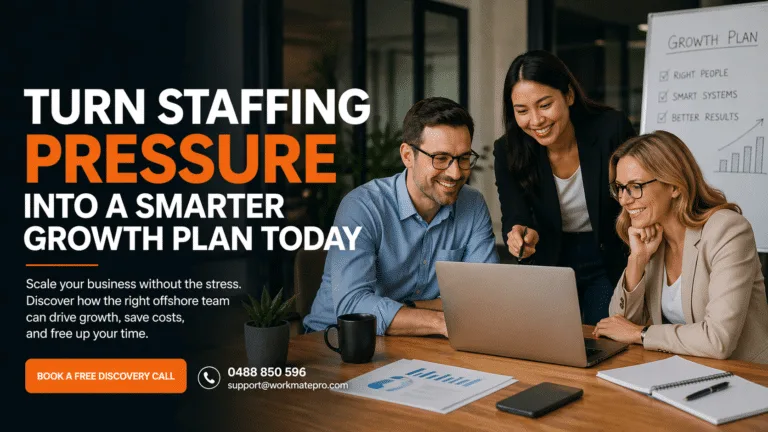
Turn staffing pressure into a smarter growth plan by stepping back before you rush into another hire. When a business starts feeling stretched, it is easy to assume the only answer is to add more people as quickly as possible. But pressure inside a team does not always mean you need another full-time local employee straight away. In many cases, the real issue is unclear workload, inefficient systems, poor delegation, or roles that have expanded beyond their original purpose.
For Australian employers, staffing decisions in 2026 need to be more deliberate. Labour costs remain high, expectations around service and speed are rising, and small to medium businesses cannot afford hiring mistakes that drain time and budget. This is why leaders need a smarter growth plan instead of a reactive recruitment plan. When businesses learn how to turn staffing pressure into a more strategic hiring approach, they can make better decisions about support, structure, and the type of help the business actually needs.
When work piles up, business owners and managers often feel immediate urgency. Deadlines are slipping, inboxes are growing, and key staff are stretched across too many responsibilities. In that moment, fast hiring can feel like the responsible move. The problem is that rushed hiring often solves the wrong issue.
Sometimes the pressure comes from duplicated tasks, poor systems, or the fact that experienced people are spending too much time on low-value work. Turn staffing pressure into a smarter growth plan by identifying where the strain is really coming from. If you hire before diagnosing the cause, you risk adding cost without solving the operational bottleneck.
A new hire also comes with onboarding time, training demands, and management effort. If the role is vague or the workflow is not clear, that new person may add complexity rather than relief. Smart employers know that the goal is not just to reduce pressure today. It is to build a business structure that can support growth tomorrow and turn staffing pressure into a more sustainable plan for the business.
Before making any staffing decision, review what your team is actually doing. Not what people seem busy with, but the real work happening across the week. This includes recurring tasks, urgent requests, client-facing duties, project work, admin time, follow-ups, and internal coordination. This is the first step to turn staffing pressure into a smarter growth plan, because it shows where support is truly needed.
This kind of review often reveals that high-value team members are buried in repetitive work. A manager may be handling diary changes and chasing documents. A founder may be replying to routine customer enquiries. A specialist may be updating reports instead of focusing on delivery. These are signs that capacity is being lost in the wrong places.
By mapping where time is going and what type of support could create immediate relief, businesses can turn staffing pressure into better decisions. Once you can see which tasks are strategic and which are repeatable, it becomes easier to decide whether you need a full-time hire, a part-time solution, or offshore support.
One of the most common hiring mistakes is creating a role based on a random list of tasks. Employers often say they need help, but they are not clear on what the new person should actually achieve. This leads to confusion during recruitment and weak results after onboarding. To turn staffing pressure into a smarter growth plan, employers need to define the purpose of the role before they begin hiring.
A better approach is to define the outcome first. Should this role free up leadership time? Improve response times? Reduce admin backlog? Support project coordination? Strengthen customer experience? When success is defined clearly, the hiring brief becomes far more effective.
By focusing on results instead of vague activity, businesses can turn staffing pressure into a stronger role design. This also helps businesses choose the right level of support. Some problems need a senior hire. Others need a capable administrator, executive assistant, or customer support representative who can keep operations moving smoothly.
Businesses often feel overwhelmed because important people are doing the wrong type of work. Leaders, specialists, and revenue-driving staff should not be spending large parts of their week on tasks that can be delegated. When they do, the business slows down and growth becomes harder to sustain. This is why businesses need to turn staffing pressure into a smarter growth plan by making sure high-value people stay focused on high-value work.
This is particularly important for small and medium businesses, where people naturally take on extra responsibilities over time. The owner starts handling admin. The operations manager picks up scheduling. The sales lead becomes the person fixing service issues. It may feel practical in the short term, but it is not sustainable.
Turn staffing pressure into a smarter operating model by separating growth work from support work. Keep strategy, relationship management, and decision-making with the right internal leaders. Then move admin, coordination, bookkeeping, social media support, and customer service to roles designed for those functions. This creates better focus across the team and gives the business room to grow.
For many Australian businesses, offshore staffing has become one of the most practical ways to improve capacity without overextending the budget. It allows employers to access skilled professionals who can take ownership of important support functions while local teams stay focused on leadership, sales, and client outcomes.
This is especially useful for roles such as virtual assistants, administrators, executive assistants, customer support representatives, graphic designers, bookkeepers, web developers, and project support staff. These roles often provide immediate relief because they remove the repetitive or time-consuming tasks that keep businesses stuck. This is one of the most effective ways to turn staffing pressure into a smarter growth plan without adding unnecessary overhead.
By carefully deciding which roles need to be local and which can be handled remotely, businesses can turn staffing pressure into a scalable team strategy. This does not mean lowering standards. It means structuring your team in a way that uses talent wisely. With the right systems, communication, and expectations, offshore professionals can become dependable long-term contributors to business growth.
Hiring alone cannot fix poor workflow. If tasks are unclear, approvals are slow, and accountability is vague, more people will only magnify the issue. That is why strong businesses improve their systems before or alongside any staffing decision, especially when they want to turn staffing pressure into long-term operational improvement.
Document your recurring processes. Clarify who owns what. Simplify communication channels. Set clear turnaround expectations. Make handovers easier. These small changes can dramatically improve team efficiency without requiring immediate expansion.
Turn Staffing Pressure into operational clarity by removing friction inside the business first. When systems are clean, new support becomes far more effective. Team members can step into their role with confidence because expectations, priorities, and processes are already in place.
A smart growth plan looks beyond the pressure you feel today. It also considers what the business will need over the next six to twelve months. Are you preparing for a seasonal peak? Launching a new service? Taking on larger clients? Expanding into new markets? Future demand should shape how you think about support.
Employers who plan ahead are able to recruit proactively instead of reactively. They bring in help before service standards drop or staff burnout becomes a risk. They also have more flexibility to choose the right solution rather than grabbing the first available option.
Turn Staffing Pressure into long-term readiness by forecasting what your business will need next, not just what feels urgent now. That kind of planning helps every staffing investment deliver more value.
The strongest teams are not always the biggest teams. They are the clearest teams. Everyone knows their role, work is distributed properly, and support is added where it has the greatest impact. That is how businesses turn staffing pressure into a more focused, productive, and less reactive workplace.
When businesses keep pushing overloaded staff without improving structure, performance eventually suffers. Morale drops, mistakes increase, and leaders spend too much time firefighting. A smarter growth plan changes that. It gives the business a way to grow with intention rather than pressure.
Turn Staffing Pressure into an opportunity to redesign how your business operates. With clearer roles, better systems, and the right support model, you can build a leaner, stronger team that is ready for growth.
If your business is feeling stretched, WorkMatePro can help you find skilled offshore professionals who support your operations without the cost and complexity of traditional hiring. From admin and customer support to bookkeeping, design, and executive assistance, we help Australian businesses create practical staffing solutions that match real business needs.
Turn Staffing Pressure into a smarter path forward by choosing support that improves capacity, protects your budget, and gives your local team more room to focus on high-value work. That is how sustainable growth starts.
© 2026 WorkMatePro. Website by Bsharptech
Strategy by Bullseye