
Role scorecards are one of the most underused tools in the hiring process, particularly among small and medium-sized businesses in Australia. When employers skip this step, they often end up hiring someone who looks good on paper but does not actually fit the role they had in mind. The result is wasted time, wasted money, and a vacancy that needs to be filled all over again. Getting role scorecards right before you begin recruiting is one of the simplest ways to improve the quality of every hire you make.
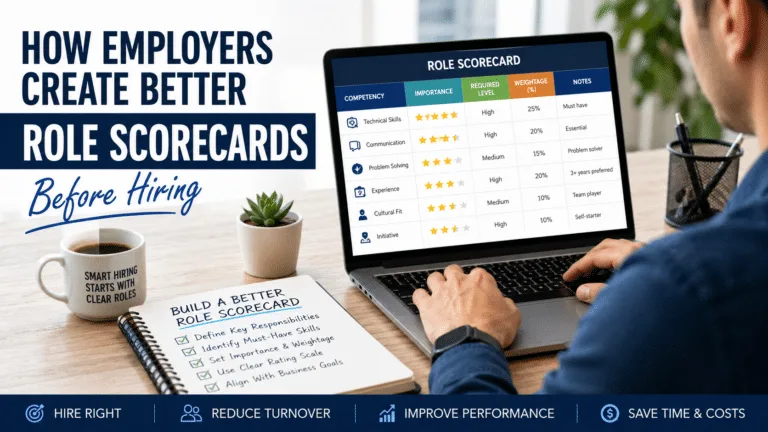
Many employers confuse role scorecards with job descriptions. They are not the same thing. A job description tells a candidate what the job involves. Role scorecards, on the other hand, are an internal document that defines exactly what success looks like for the person filling that position. They outline the specific outcomes expected, the competencies required, and the measurable standards that will be used to evaluate performance.
When used correctly, role scorecards give hiring managers a consistent framework to assess every candidate against the same criteria. This removes a significant amount of guesswork from the process and makes it far easier to compare applicants objectively.
Hiring without a defined scorecard is a bit like building without a blueprint. You might know roughly what you want, but without a clear plan, the end result rarely matches your expectations. Business owners who have experienced a string of disappointing hires often trace the problem back to this one gap. They never clearly defined what the role needed to deliver.
This problem is even more pronounced when hiring offshore. Without role scorecards to guide the process, it becomes very difficult to brief a staffing partner accurately, assess candidates fairly, or set expectations with a new hire from day one. The absence of that structure is often what leads to the frustration many employers feel after a failed remote hire.
Effective role scorecards do not need to be lengthy or complicated. What they do need is clarity. Every scorecard should begin with a clear statement of the role’s primary purpose: why this position exists and what it is designed to achieve. From there, you build out the specific outcomes the person in this role is responsible for delivering.
The next layer of role scorecards covers competencies. These are the skills, behaviours, and attributes that will determine whether someone can actually deliver those outcomes. For an offshore virtual assistant, this might include strong written communication, attention to detail, the ability to manage multiple priorities, and proficiency in specific software tools.
Finally, well-structured role scorecards include measurable performance indicators. These are the benchmarks you will use at the 30, 60, and 90-day marks to assess whether the new hire is tracking as expected. Having these written down before hiring begins also helps with onboarding, because your new team member knows exactly what they are being measured against.
Building role scorecards for offshore positions follows the same principles as building them for local hires, with a few additional considerations. Because your offshore team member will be working remotely and potentially across different time zones, the scorecard needs to be more explicit about communication expectations, reporting rhythms, and the tools they will use to stay connected with your onshore team.
Start by mapping out the tasks your offshore hire will own day to day. Then ask yourself what good performance actually looks like for each of those tasks. Role scorecards become most useful when they translate vague expectations into specific, observable outcomes. For example, “manages our inbox” becomes “responds to all customer enquiries within four business hours and maintains an inbox zero policy.”
WorkMatePro works with Australian employers to build role scorecards that are practical, clear, and aligned with the realities of offshore staffing. This preparation stage is part of what makes the placement process more effective and reduces the likelihood of a mismatch.
Once this framework is in place, it becomes a practical guide throughout every stage of hiring. During interviews, use the competency section to frame your questions. Instead of asking generic questions about strengths and weaknesses, you can ask targeted questions designed to assess whether a candidate has demonstrated the specific behaviours and skills identified as essential.
After each interview, score candidates against the same criteria. This gives you a consistent record of each candidate’s performance and makes the final decision far easier to justify, whether you are making it alone or with input from other team members.
The value of role scorecards does not end when you make a hire. They carry directly into onboarding. Sharing the scorecard with your new team member on day one sets the tone for the entire working relationship. It tells them clearly what they are expected to deliver, how their performance will be evaluated, and what success looks like in this role.
For offshore staff, this transparency is especially valuable. When someone is working remotely and cannot simply walk over to ask a question, having role scorecards as a reference point gives them the clarity and confidence to get started without constant check-ins. It also gives you a fair and documented basis for any performance conversations down the track.
If you have been hiring without a structured evaluation framework, you are not alone. Most small business owners have never been shown how to build one or why it makes such a significant difference. WorkMatePro helps Australian employers get this foundation right before the recruitment process begins, so that every hire is aligned with what the business actually needs.
Whether you are looking to hire a virtual assistant, a bookkeeper, or a customer support representative, the process starts with clarity. Well-constructed role scorecards give you that clarity. They also give your staffing partner the information needed to source candidates who are genuinely suited to the role, rather than simply available.
Building a reliable offshore team is absolutely achievable. Taking the time to get your hiring criteria right before recruitment begins is one of the most practical steps you can take to make sure every placement delivers the results your business is counting on.

© 2026 WorkMatePro. Website by Bsharptech
Strategy by Bullseye