
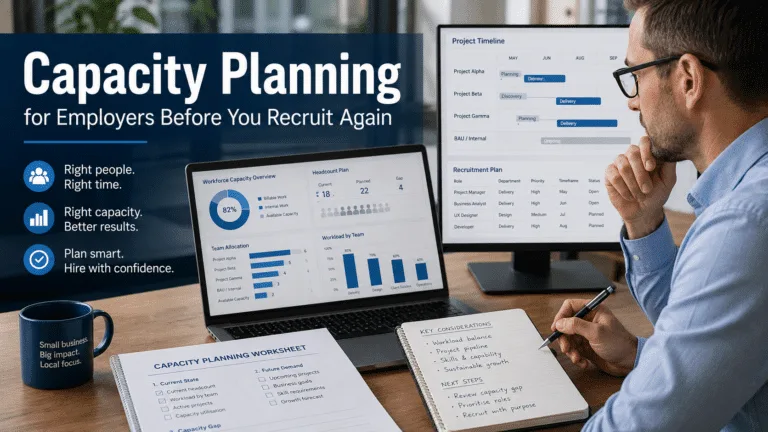
Capacity planning is the step most employers skip before they open a new position. Instead of asking whether the business genuinely needs another person, or what that person should actually be doing, many business owners jump straight to writing a job ad based on how busy things feel at the time. The result is a hire that may solve the immediate pressure but does not address the underlying gap. Doing proper capacity planning before you recruit again is what separates businesses that build strong, efficient teams from those that are constantly hiring, onboarding, and replacing staff.
Capacity planning, at its core, is the process of understanding how much work your team can realistically handle and identifying where the gaps are. For small and medium-sized businesses in Australia, this is not about complex workforce modelling or spreadsheets full of data. It is about taking an honest look at what your current team is being asked to do, where time is being wasted, and where work is falling through the cracks.
When you approach capacity planning with clarity, you quickly learn whether you need an additional hire at all. Sometimes the issue is not a lack of people. It is that the wrong people are doing the wrong tasks. Redistributing work, automating repetitive processes, or bringing in targeted offshore support can often solve the problem without the cost and complexity of a full-time local hire.
Recruiting without a clear understanding of your capacity needs is expensive in more ways than one. There is the obvious financial cost of advertising, interviewing, and onboarding. But there is also the less visible cost of hiring someone into a role that was never properly defined, watching them underperform because expectations were unclear, and then having to start the process all over again.
Capacity planning helps you avoid this cycle. When you know exactly what your team needs, how many hours of effort certain tasks require, and which functions could be handled by offshore support, you go into recruitment with a much stronger brief. That brief leads to better candidates, faster decisions, and hires who are set up to succeed from the start.
The first step in capacity planning is a workload audit. This means sitting down with your existing team members, or working through it yourself if you are a sole operator, and mapping out what each person spends their time on. Look at recurring tasks, project-based work, and the ad hoc requests that tend to eat into productive hours without ever appearing on anyone’s to-do list.
What you are looking for are two things: tasks that are consuming more time than they should, and tasks that are not getting done at all because there is no one to own them. Both of these are signals that your team is operating beyond its capacity, but they point to different solutions. Overloaded tasks often indicate a need for support or process improvement. Incomplete tasks often indicate a role that needs to be created.
One of the most useful outputs of a capacity planning exercise is a clearer picture of where your highest-value people are spending their time. In most small businesses, skilled and experienced team members are regularly pulled into low-value administrative tasks because there is no one else to handle them. This is one of the most common and costly forms of capacity waste.
Capacity planning gives you the data to make a different decision. Once you can see that your operations manager is spending twelve hours a week on data entry, scheduling, and inbox management, you have a strong case for bringing in offshore administrative support. That one change can free up significant hours for the kind of strategic work your senior people were actually hired to do.
Once you have completed your capacity planning review, you will often find that a significant portion of the work that is overwhelming your team does not actually need to be done in Australia. Administration, customer support, bookkeeping, social media management, and data processing are all functions that can be handled effectively by skilled offshore professionals in the Philippines.
This is where WorkMatePro adds real value to the capacity planning process. Rather than treating recruitment as a binary choice between hiring locally or not hiring at all, WorkMatePro helps Australian businesses identify which roles are best suited to offshore support and then places the right person quickly, starting from $12.50 AUD per hour.
The combination of lower cost and faster placement means that businesses can respond to capacity gaps much more efficiently than they could through the local hiring market. And because WorkMatePro manages recruitment, payroll, and office infrastructure in the Philippines, the operational burden on the Australian business owner is minimal.
Effective capacity planning is not just about solving today’s problems. It is also about anticipating the demands your business will face over the next six to twelve months. If you are expecting revenue to grow, a new product to launch, or a key team member to take leave, your capacity needs will shift. Building that forecast into your hiring decisions means you are not always reacting to a crisis.
Capacity planning with a forward-looking lens also helps you stage your hiring in a way that makes financial sense. Rather than bringing on multiple people at once and hoping the revenue covers the cost, you can prioritise the roles that will have the most immediate impact and sequence the rest as the business grows into them.
Once your capacity planning assessment is complete, you have everything you need to build a precise hiring brief. You know which tasks are consuming the most time, which functions are being neglected, and what kind of support would make the biggest difference. That information translates directly into a clear role description, a defined set of responsibilities, and realistic performance expectations.
A hiring brief built on solid capacity planning is significantly more effective than one written in the middle of a busy period based on gut feel. It gives your staffing partner the context needed to find a candidate who genuinely fits the role, and it gives your new hire a clear picture of what they are walking into from day one.
The best time to do capacity planning is before you feel the pressure to hire, not after you are already stretched thin. When you approach recruitment from a position of clarity rather than urgency, you make better decisions. You hire for the right reasons, define the role properly, and give your new team member the best possible chance of succeeding.
WorkMatePro works with Australian employers at every stage of this process. Whether you are trying to figure out what role to hire next, which functions could be handled offshore, or how to structure your team as the business grows, the conversation starts with understanding your capacity. Reach out to WorkMatePro to talk through what your business actually needs before you post your

© 2026 WorkMatePro. Website by Bsharptech
Strategy by Bullseye