
Hiring an offshore team member is the easy part. Managing offshore staff well, day in and day out, is what determines whether the arrangement becomes a genuine asset to your business or a source of constant friction. If you’ve already brought on offshore staff, or you’re about to, this guide walks through what changes when part of your team works from the Philippines rather than down the hall, and what you need to put in place to manage that team properly.
This is a long, practical piece. Use the headings below to jump to what’s most relevant to you, and follow the links through to the more detailed articles on specific topics — this page is meant to be the map, not the only resource you’ll need.
Why managing an offshore team is different from managing local staff
Managing offshore staff in Australia isn’t the same job as managing someone in your own office, and pretending otherwise is where most of the early frustration comes from. In a local team, a huge amount of management happens informally — you notice someone’s stuck and wander over, you overhear a conversation that flags a problem, you read body language in a meeting. None of that exists when your team member is in Manila or Cebu and you’re in Sydney or Perth.
Three things change in particular. First, timezone and physical distance mean you lose the informal, ambient supervision that local offices run on. Second, the cultural and communication norms are different — Filipino professional culture tends to be more deferential to authority and less likely to proactively flag problems or push back on a manager’s instructions, which means you need to actively invite that feedback rather than assume it will surface on its own. Third, and most importantly, everything that used to happen “in the room” now has to happen in writing. Instructions, expectations, decisions and feedback all need to be documented, because there’s no hallway conversation to fall back on when something is unclear.
None of this means offshore team management is harder in some fundamental sense — it means it rewards a more deliberate, process-driven approach. Businesses that try to manage offshore staff exactly the way they manage local staff, with the same loose, informal habits, are usually the ones that end up disappointed. The businesses that build a bit more structure around communication, documentation and check-ins tend to get outstanding results, often better than what they had locally, simply because the structure benefits everyone.
Communication and timezone alignment
Remote staff management lives or dies on communication. Because a managed offshore arrangement has your team member working hours aligned to Australian business hours, timezone isn’t the obstacle it can be with other outsourcing models — but you still need to be deliberate about how and when you communicate.
Set a cadence of check-ins
A short daily stand-up (10–15 minutes, video on) and a slightly longer weekly one-on-one are the backbone of good offshore team management. The daily check-in surfaces blockers before they cost a full day; the weekly one-on-one is where you deal with priorities, workload, and anything more substantial. Skipping these because “everything seems fine” is usually how small misunderstandings turn into missed deadlines.
Balance async and sync communication
Not everything needs a live call. Status updates, routine questions and documentation are better handled asynchronously through chat and shared docs, so your team member isn’t blocked waiting on you and you’re not pulled into meetings all day. Reserve synchronous time (calls, video meetings) for things that genuinely benefit from back-and-forth discussion — planning, feedback conversations, or untangling a genuinely ambiguous problem. Getting this balance wrong in either direction — everything as a meeting, or everything as a message with no live contact — tends to erode the relationship over time.
Define core overlap hours
Even with aligned working hours, agree explicitly on the block of time each day when both you and your offshore team member are expected to be reachable in real time. This is where quick decisions get made and questions get answered without a 12-hour delay. Outside that window, default to async unless something is urgent. Being explicit about this avoids the common trap where a manager assumes availability that was never actually agreed.
Onboarding and documentation
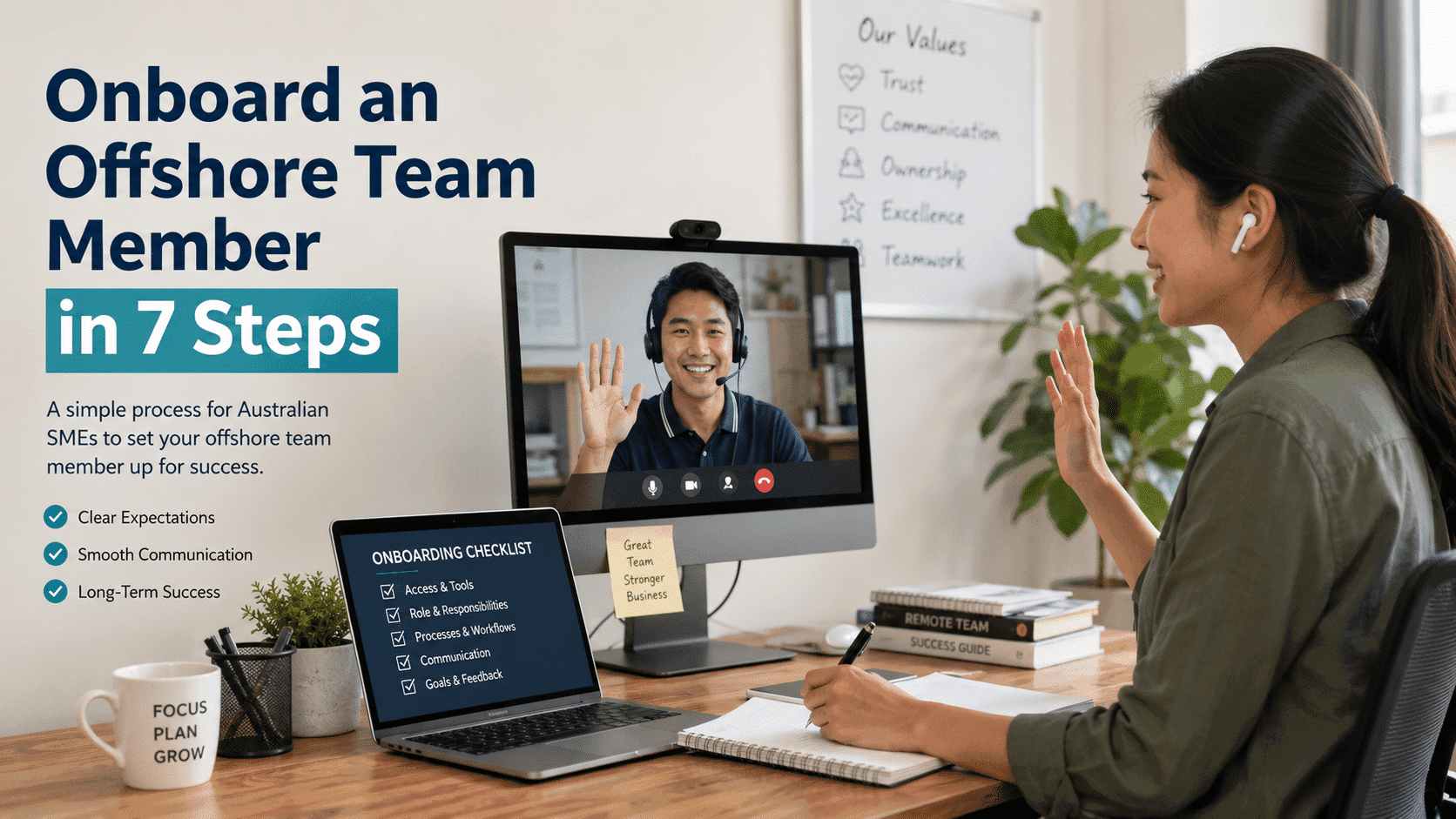
Onboarding matters more with offshore staff than with local hires, not less. A new local employee can absorb a lot of context just by being physically present — overhearing conversations, watching how colleagues handle things, asking a quick question across the desk. A new offshore team member doesn’t get any of that by default, so the quality of your onboarding and documentation directly determines how fast they become productive.
This starts with a clear role scorecard — a written description of what success looks like in the role, the outcomes the person is accountable for, and the standards they’ll be measured against. We cover how to build these properly in our article on setting role scorecards for offshore positions, but the short version is: don’t leave the definition of “doing a good job” to inference. Write it down before the person starts.
Alongside the scorecard, you need documented processes — SOPs (standard operating procedures) for recurring tasks, and playbooks for how decisions get made in your business. If you don’t already have a library of these, building one is one of the highest-leverage things you can do for managing offshore staff in Australia, because it means a new hire can self-serve answers instead of waiting on you. Our article on reducing onboarding time with SOP libraries and playbooks goes through how to build this out without it becoming a huge upfront project. For the onboarding sequence itself — what to cover in week one, how to structure the first month, and how to avoid the common mistakes that slow new offshore hires down — see our dedicated guide on how to onboard an offshore team member.
It’s worth treating onboarding as an investment rather than an administrative box to tick. A well-documented onboarding process pays for itself many times over, both for your first offshore hire and for every one after that, because the documentation gets reused and refined rather than rebuilt from scratch.
Tools and tech stack
You don’t need an enormous or expensive tech stack to manage offshore staff well, but you do need to cover a handful of categories deliberately rather than cobbling things together as problems come up.
Project and task management — a shared system where work is assigned, tracked and prioritised, so nothing lives only in someone’s inbox or memory. This is what gives you visibility into what your offshore team member is working on without needing to ask.
Communication tools — a mix of instant messaging for quick, informal contact and video conferencing for face-to-face check-ins. Keeping video on for regular calls matters more than it seems; it maintains a personal connection that pure text can’t.
File and password sharing — a proper shared drive or document system, and a password manager for anything that needs credentialed access. Sending passwords over chat or email is a habit worth breaking immediately, for security reasons covered in more detail below.
Time tracking and reporting — some form of visibility into hours worked and time spent on tasks, both for payroll accuracy and so you have an objective record to refer to if output and hours ever seem mismatched.
We deliberately haven’t named specific paid products here — the right stack depends on what you’re already using and the size of your team. For a fuller rundown of tool categories specifically aimed at supporting remote and offshore workers, see our article on tools for supporting remote workers.
Culture and engagement for distributed teams
One of the quiet risks in offshore team management is letting your offshore staff feel like a second-class part of the business — included when convenient, left out of anything that resembles “the real team.” This rarely happens deliberately. It happens by default, because it takes active effort to include someone who isn’t physically in the building, and that effort is easy to skip when things get busy.
Deliberately include offshore team members in team rituals — all-hands meetings, celebrations, casual channels, not just the meetings where work gets assigned. Recognise good work publicly, the same way you would for a local employee; recognition that only ever happens in a private message reads very differently to someone than recognition that happens in front of the team. Small things compound here: acknowledging birthdays and work anniversaries, inviting input on decisions that affect their work, and making sure they’re never the last to hear about changes that affect the business.
Getting this right is genuinely one of the biggest differentiators between businesses that get years of loyal, high-quality work from their offshore staff and those that deal with high turnover. Our article on building culture for distributed teams goes into this in more depth, including how to run rituals that work across a split team without feeling forced.
Investing in your offshore team member’s growth also matters here — offering training, new responsibilities and a genuine career path signals that the role is a long-term one, not a stopgap. See our piece on training and development for offshore staff for practical ways to build this in without a large budget.
Performance management and data security
Good performance management for offshore staff starts with the same scorecard you built during onboarding — clear, written KPIs that define what success looks like, reviewed regularly rather than left to an annual conversation. Vague expectations are the single biggest cause of performance issues in offshore arrangements, and they’re almost always a management gap, not a skills gap. If you haven’t set this up yet, revisit the guidance on role scorecards above before assuming a performance problem is about the person rather than the process.
Visibility matters too, in both directions. You need enough insight into your offshore team member’s work to manage it properly, and they need enough visibility into the business and its priorities to do their job well and feel like a genuine part of the team. Our article on why visibility matters in offshore team management covers how to strike this balance without tipping into micromanagement.
On the security side, offshore staff will typically need access to some combination of your systems, client data, financial information, or communication tools. Treat access control the same way you would for any employee: grant only what’s needed for the role, use a password manager rather than sharing credentials directly, and review access periodically, particularly when a role changes. Our detailed article on data security for offshore teams covers the specific practices worth putting in place, from account access through to handling client data responsibly.
It’s also worth revisiting your team’s structure and workload periodically rather than assuming today’s setup is right forever. Our articles on capacity planning for offshore teams and reducing overhead without reducing output are useful reading if you’re trying to work out whether you have the right number of people doing the right things, or whether admin and management overhead has crept up without a corresponding increase in results.
Handling underperformance and difficult conversations with an offshore team member
Even with a good scorecard and a solid onboarding process, performance issues will come up occasionally — the same as they would with any employee. How you handle them matters more in an offshore, cross-cultural, remote arrangement than it does locally, because the usual informal correction mechanisms (a quiet word, a raised eyebrow in a meeting) don’t really exist, and the cultural default toward indirectness can mean issues get missed or softened on both sides.
Work out whether it’s a skills gap or a management gap
Before you frame anything as a performance problem, check your own side of the ledger. Go back to the role scorecard: was the expectation actually written down and communicated clearly, or was it assumed? Look at whether the SOPs and playbooks covering the task were actually in place, or whether the person was working from incomplete instructions. A surprising number of “performance issues” in offshore arrangements are really documentation or communication gaps — an unclear brief, a process that was never written down, or a check-in cadence that was too thin to catch a misunderstanding early. If the same issue is affecting more than one team member, or keeps recurring across different tasks, that’s a strong signal the gap is in your process rather than in the person.
Once you’ve ruled that out, a genuine skills or fit gap looks different: the expectations were clear, the resources were there, feedback has already been given at least once, and the same shortfall is still showing up. That’s the point where a direct conversation is warranted.
Have the conversation directly, but respectfully
This is where a lot of Australian managers get it wrong in the other direction — trying to soften a correction so much, out of politeness or to avoid seeming harsh across a cultural and remote divide, that the actual message doesn’t land. Filipino professional culture tends to favour a more indirect communication style and a good deal of deference to management, which means an employee is less likely to push back or ask clarifying questions if your feedback is vague. If you say something like “maybe we could look at tightening this up a bit,” it’s easy for that to be heard as a mild suggestion rather than the clear correction you meant it to be.
The better approach is to be specific and direct about the gap while keeping the tone respectful and constructive. Name the exact behaviour or outcome that needs to change, reference the standard from the scorecard, and be explicit about what “fixed” looks like and by when. Do this on a video call rather than in writing where possible — tone is far easier to misread in a chat message, and a live conversation gives the person a real chance to ask questions or explain context you might be missing. Always leave room for their side of the story; a gap that looks like underperformance from your end sometimes has a legitimate explanation, such as conflicting instructions or an unclear handover. Follow the conversation up with a short written summary of what was agreed, so there’s no ambiguity about expectations going forward and no reliance on memory alone.
Know when to involve your staffing provider
If you’ve had a direct conversation, set clear expectations, given a reasonable window to improve, and the issue still isn’t resolving, that’s the point to loop in your staffing provider rather than continuing to manage it alone. A good managed offshore arrangement includes support for exactly this situation — the provider can help mediate a conversation, offer a local, culturally informed perspective on what might be going on, arrange additional training, or, if necessary, manage a transition to a different team member. Involving the provider early once a pattern is clear tends to produce a better outcome than waiting until frustration has built up on both sides, and it’s a normal, expected part of the support a managed arrangement is there to provide — not a sign that something has gone badly wrong.
Compliance considerations
Compliance is one area where a managed offshore staffing arrangement takes a genuine load off your plate. In a managed model, the provider typically handles Philippine employment compliance, statutory benefits and payroll on your behalf, so you’re not required to become an expert in Philippine labour law to employ someone there.
That said, there are Australian-side considerations worth being aware of — around contracts, data handling obligations, workplace conduct standards (see the Fair Work Ombudsman for general guidance), and how the arrangement is structured — and this is a big enough topic that it deserves its own treatment rather than a rushed summary here. Our dedicated article on remote payroll and compliance covers both sides of this properly. If compliance is a significant concern for your business, that’s the article to read next.
FAQ
How often should I check in with my offshore team member?
A short daily stand-up plus a weekly one-on-one is a solid default for most roles. Adjust the frequency based on seniority and how established the working relationship is — newer hires generally need more frequent contact, while experienced team members in well-defined roles may need less.
What’s the biggest mistake Australian businesses make when managing offshore staff?
Assuming offshore staff can be managed exactly like local staff, with the same loose, informal communication habits. Offshore team management rewards clear written expectations, documented processes and a deliberate communication cadence — skipping this is where most avoidable problems start.
Do I need to buy expensive software to manage an offshore team?
No. You need coverage across a few categories — project management, communication, file and password sharing, and time tracking — but there’s no single “must-have” paid tool. Many businesses run this well on tools they already use, adjusted slightly for a distributed team.
How do I avoid my offshore team feeling excluded from the rest of the business?
Actively include them in team rituals, celebrations and recognition, not just task assignment. Give them visibility into business priorities and decisions that affect their work, and invest in their development so the role reads as a genuine long-term position rather than a stopgap.
Who handles compliance and payroll for offshore staff?
In a managed offshore staffing arrangement, the provider typically handles Philippine employment compliance, statutory benefits and payroll administration. There are still Australian-side considerations to be aware of, which we cover in detail in our article on remote payroll and compliance.
If you’re building or refining how you manage an offshore team and want a second set of eyes on your setup, book a free strategy call with WorkMate Pro and we’ll talk through what’s working, what isn’t, and what a well-managed offshore arrangement should look like for your business.