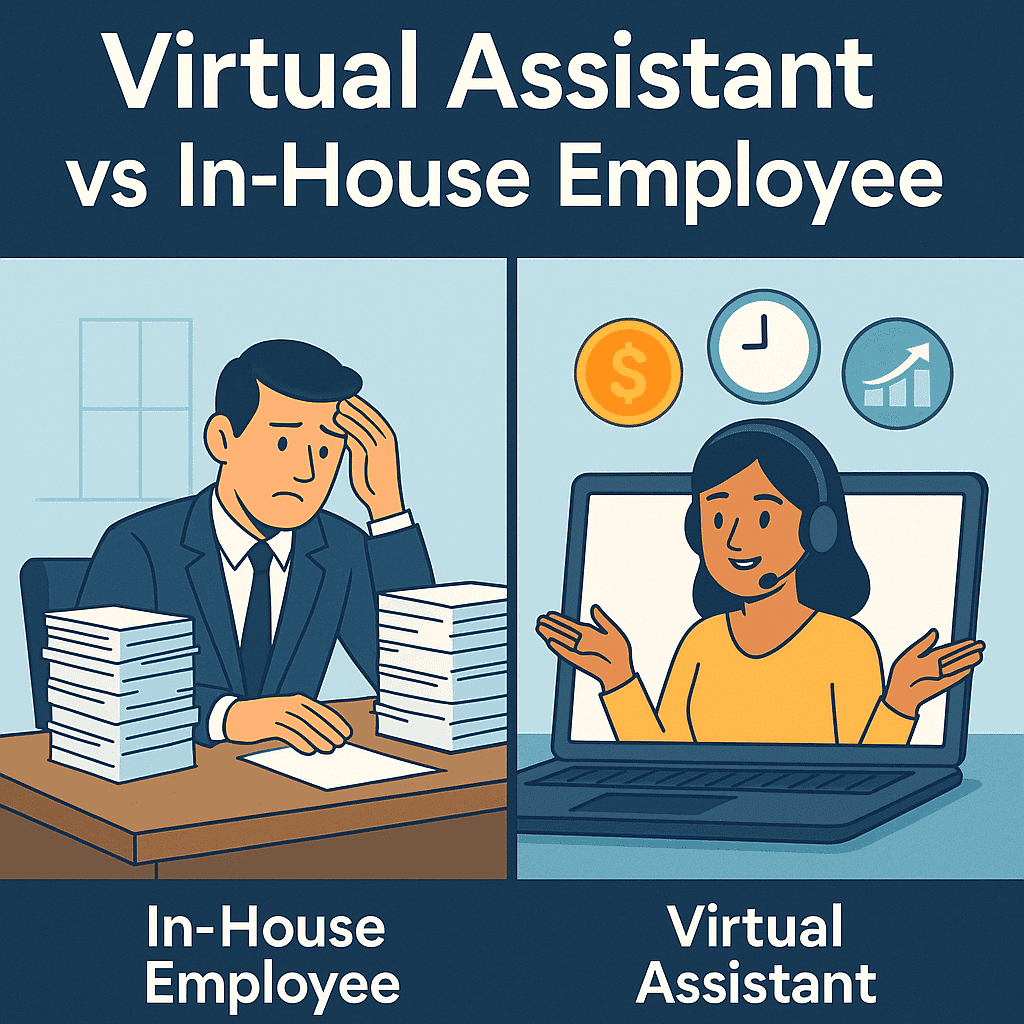
virtual assistant vs in-house employee : Which Is Better for Your Business?
Running a business comes with endless responsibilities — from managing clients and finances to handling admin and marketing. At some point, every business owner asks the same question: “Should I hire an in-house employee or a virtual assistant?”
Both options come with benefits, but the best choice depends on your goals, budget, and long-term strategy. In this article, we’ll compare virtual assistants (VAs) vs in-house employees across key areas like cost, productivity, flexibility, and growth potential — so you can make the best decision for your business.
1. Understanding the Roles
Before we dive into comparisons, let’s clarify the difference between a virtual assistant and an in-house employee.
-
Virtual Assistant (VA): A remote professional who handles specific tasks or ongoing support. They can be part-time, full-time, or project-based. You only pay for the services you need.
-
In-House Employee: A staff member who works directly in your office (or hybrid). You cover their full salary, benefits, and overhead costs.
Both can deliver value, but the way you work with them is very different.
2. Cost Comparison
One of the most significant differences between VAs and in-house employees is cost.
-
Virtual Assistants:
-
Typically charge by the hour or a fixed monthly rate.
-
No need to pay for office space, equipment, or employee benefits.
-
Businesses can save up to 60–70% in labour costs by outsourcing to countries like the Philippines.
-
-
In-House Employees:
-
Require a full salary, superannuation, sick leave, annual leave, and insurance.
-
Additional costs include office space, utilities, training, and IT support.
-
👉 If you’re on a budget or need support without long-term commitments, a VA is the more cost-effective option.
3. Flexibility and Scalability
Business needs change quickly, and flexibility is crucial.
-
Virtual Assistants:
-
Scale your team up or down based on workload.
-
Hire part-time or project-based support when needed.
-
Perfect for businesses with seasonal fluctuations or start-ups testing new roles.
-
-
In-House Employees:
-
Provide long-term stability but are harder to scale.
-
Hiring and onboarding take time, and reducing staff can be costly.
-
👉 If you want agility, VAs give you the flexibility to grow without the risks of overstaffing.
4. Productivity and Efficiency
When comparing productivity, the structure of the role matters.
-
Virtual Assistants:
-
Focused on completing specific tasks.
-
Work output is results-driven.
-
Less time wasted on commuting or office distractions.
-
-
In-House Employees:
-
Often take on a broader scope of responsibilities.
-
Can be pulled into office tasks outside their main role.
-
May spend more time in meetings or admin unrelated to their strengths.
-
👉 For task-focused work, VAs often deliver higher productivity per dollar spent.
5. Skills and Expertise
Both VAs and in-house employees bring valuable skills, but in different ways.
-
Virtual Assistants:
-
Many specialise in areas like digital marketing, bookkeeping, customer service, or social media.
-
You can hire a VA for specific expertise without training them from scratch.
-
Global outsourcing markets (like the Philippines) give access to a diverse talent pool.
-
-
In-House Employees:
-
Provide hands-on support and can take on tasks requiring physical presence.
-
Easier to mentor and train for company-specific processes.
-
May lack specialised skills unless hired for a senior role.
-
👉 If you need specialised skills quickly and affordably, a VA is often the better choice.
6. Communication and Collaboration
Clear communication is essential in any team.
-
Virtual Assistants:
-
Work remotely, so collaboration relies on tools like Slack, Zoom, or Trello.
-
Time zone differences can be an advantage (overnight work completed by next day).
-
Requires clear processes and expectations to avoid miscommunication.
-
-
In-House Employees:
-
Easier to collaborate face-to-face.
-
Immediate availability for in-person tasks and meetings.
-
Stronger integration into company culture.
-
👉 If your work is heavily collaborative or requires constant physical presence, an in-house employee might be more effective.
7. Long-Term Business Growth
Your choice between a VA and an in-house employee also affects long-term growth.
-
Virtual Assistants:
-
Allow you to focus on high-value activities by taking routine work off your plate.
-
Enable lean business models with lower overheads.
-
Best suited for start-ups, SMEs, or businesses expanding into new markets.
-
-
In-House Employees:
-
Strengthen internal culture and loyalty.
-
Provide stability for roles requiring long-term company knowledge.
-
Suitable for businesses with steady growth and budget to support expansion.
-
👉 Many businesses find a hybrid model works best — outsourcing repetitive tasks to VAs while keeping core roles in-house.
8. Real-World Scenarios
To put this into perspective, here are examples of when to choose a VA vs an in-house employee:
-
When a Virtual Assistant makes sense:
-
A real estate agent outsources lead generation, saving 15 hours a week.
-
A start-up hires a VA for social media management, avoiding a full-time marketing hire.
-
An e-commerce business outsources customer service to a VA team, ensuring 24/7 support.
-
-
When an In-House Employee makes sense:
-
A retail store hires an in-house manager to oversee daily operations.
-
A law firm employs a paralegal who needs constant physical access to case files.
-
A company requires a role deeply embedded in culture, such as HR or team leadership.
-
9. Which Option Is Best for You?
To decide between a VA and an in-house employee, ask yourself:
-
Do I need physical presence or can this task be done remotely?
-
Is this a long-term, full-time need or a task-based requirement?
-
Do I want to save costs or invest in building internal culture?
-
How quickly do I need this role filled?
If your priorities are cost savings, flexibility, and task efficiency, a virtual assistant is the clear winner.
If you need physical presence, loyalty, and culture-building, then an in-house employee may be better.
Final Thoughts
Both virtual assistants and in-house employees play valuable roles in business growth. The key is to choose the right option for the right stage of your business.
-
Start-ups and SMEs often benefit most from VAs, as they provide affordability and scalability.
-
Larger, established companies may prefer in-house employees for leadership and culture-building roles.
At WorkMate Pro, we help businesses unlock the benefits of outsourcing by connecting them with skilled virtual assistants from the Philippines. With the right VA, you can save time, cut costs, and focus on what matters most — growing your business.
🔗 Call to Action
Not sure if a virtual assistant is right for you?
👉 Book a discovery call with WorkMate Pro and let us help you find the best fit for your business needs.
Follow our Socials: