
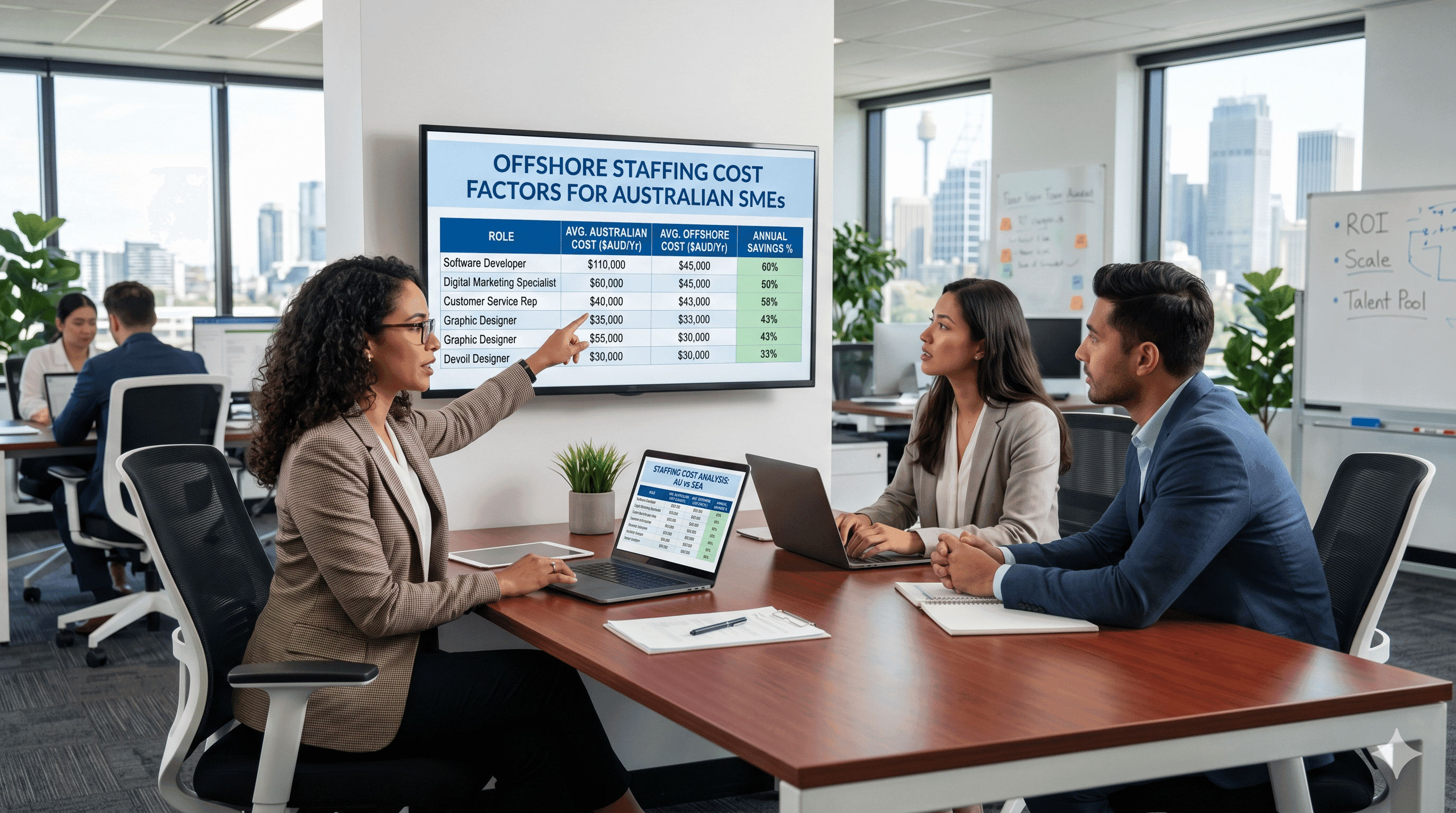
Offshore staffing is one of the most effective ways for Australian small and medium-sized businesses to reduce overheads, build capacity, and stay competitive without inflating a local payroll. But before you commit to your first hire, understanding what drives cost by role is essential. This guide breaks down the key cost factors across the most common roles so you can plan your budget with confidence.
Why Offshore Staffing Costs Vary So Much
Not all offshore roles carry the same price. Offshore staffing rates depend on a combination of skill level, experience, role complexity, and whether you are using a managed placement service or hiring independently. A bookkeeper with five years of MYOB experience commands a different rate than an entry-level administrator, and a senior web developer costs significantly more than a junior graphic designer.
Understanding these differences upfront prevents budget surprises and helps you build a business case before approaching a provider.
The Core Cost Factors That Apply Across All Roles
Regardless of the role you are looking to fill, offshore staffing costs are shaped by several common variables.
Experience and seniority are the most significant drivers. An offshore team member with three to five years of relevant experience will cost more than someone new to the workforce, but they will also require less training and supervision, which reduces your hidden costs over time.
Scope of responsibilities also plays a major role. A customer support officer handling basic enquiries sits at a different price point than someone managing escalations, reporting, and team coordination. The broader the scope, the higher the rate.
Tools and software requirements matter too. Roles that require proficiency in specialist platforms such as AutoCAD, Xero, Shopify, or project management tools typically attract higher rates than positions requiring only standard office software.
Time zone overlap affects pricing in some models. Roles that require extended overlap with Australian business hours may involve shift loading or adjusted rate structures depending on how the arrangement is set up.
Managed service vs direct hire is perhaps the most important structural factor. With a managed offshore staffing provider, you pay a placement and management fee on top of the staff member’s salary. In exchange, you get HR support, compliance management, equipment provisioning, and a buffer against attrition. Direct hiring is cheaper on paper but carries more operational risk and administrative burden.
Role-by-Role Cost Breakdown
Administrators and Virtual Assistants
This is the most common entry point for Australian SMEs exploring offshore staffing for the first time. Offshore administrators handle inbox management, scheduling, data entry, CRM updates, document preparation, and general coordination tasks.
Typical offshore staffing rates for administrators range from $8 to $16 AUD per hour depending on experience and task complexity. A managed placement through a provider like WorkMate Pro sits within a structured monthly model that covers all employment costs, making budgeting straightforward.
Bookkeepers
Offshore bookkeeping is one of the highest-value applications of offshore staffing for SMEs. An experienced offshore bookkeeper can manage accounts payable and receivable, bank reconciliations, payroll preparation, BAS compliance support, and month-end reporting.
Offshore staffing rates for bookkeeper roles reflect technical skill and software knowledge. Proficiency in Xero or MYOB adds to the rate, but the cost remains significantly below what a local part-time bookkeeper would charge. Businesses that have historically outsourced bookkeeping to a local firm often find this model delivers the same output at a fraction of the cost.
Customer Support Officers
Offshore customer support is growing rapidly among Australian e-commerce businesses, trades, and service businesses that need consistent coverage without the overhead of a full local team.
Offshore staffing for customer support roles typically sits in the mid-range because it requires strong English communication skills, familiarity with helpdesk platforms, and the ability to follow escalation procedures accurately. The value proposition is high because customer experience directly affects retention and revenue.
Social Media Managers
An offshore social media manager can handle content scheduling, community management, reporting, caption writing, and basic graphic creation. For SMEs that have been managing social media themselves or leaving it to whoever has a spare hour, this is one of the highest-leverage offshore staffing moves available.
Rates vary based on whether the role is purely execution-focused or also involves strategy and content planning. A more strategic social media manager with platform advertising experience commands a higher rate.
Graphic Designers
Offshore graphic designers are a practical solution for businesses that need consistent brand assets but cannot justify a full-time local hire. Offshore staffing for design roles covers everything from social media templates and presentations to print collateral and web assets.
Rates reflect portfolio quality, software proficiency in tools such as Adobe Creative Suite, Canva, or Figma, and turnaround expectations. Businesses with high-volume, repeatable design needs tend to see the strongest return from this arrangement.
Web Developers
Web development is one of the more technically complex and therefore higher-cost offshore staffing categories. Rates depend heavily on the tech stack required, whether the role is front-end, back-end, or full-stack, and the level of autonomy expected.
For Australian SMEs with ongoing development needs, an offshore developer on a managed model delivers far better value than contracting local freelancers on a project-by-project basis. The consistency and institutional knowledge that builds over time with a dedicated team member is a significant advantage.
Engineers and CAD Drafters
Engineering and CAD support roles represent the premium end of offshore staffing for Australian businesses. These roles require verified credentials, industry-specific software skills, and the ability to work within strict project parameters.
Australian engineering firms increasingly use offshore CAD drafters and documentation support staff to reduce the load on senior engineers, improve turnaround on deliverables, and manage project volume without permanent headcount increases.
What You Should Budget For
When calculating the total cost of offshore staffing, factor in the staff member’s salary equivalent, the provider’s placement and management fee, onboarding time, software licences, and any equipment the provider does not supply. A reputable managed service provider will be transparent about all of these components upfront.
The combined investment, even at the higher end of the role spectrum, typically sits 40 to 60 per cent below the equivalent local hire when all employment costs are included.
Making the Right Decision for Your Business
Offshore staffing works best when the role is clearly defined, the tasks are repeatable or documented, and the employer is committed to onboarding properly. The cost savings are real, but they compound when you invest time in setting your offshore team member up for success.
If you are unsure which role to start with or how to structure the arrangement, a strategy call with WorkMate Pro can help you identify the right fit based on your current bottlenecks and budget.